Film Review: Haute Cuisine (2013)

If you haven’t seen this delightful piece of French cinema yet, this trailer should whet your appetite. 

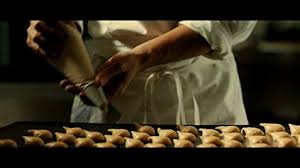
Based on the true story of Danièle Mazet-Delpeuch, Hortense Laborie, a renowned chef from Périgord, is appointed personal cook to the president at the Élysée Palace. As in any good foodie, food is central to the plot, driving relationships between some and conflict between others. 

Take it away and little remains…not to mention the countless shots of Hortense’s mouthwatering creations we would have missed out on!

Referred to as ‘Du Barry’ behind her back, Hortense battles her male counterparts for respect and ownership over the dishes produced in her kitchen. The film does little to resolve the issues it raises about ambitious women in a male-dominated industry, a trend dating back as far as the French revolutionary era (Davis 2011, 315-6). Yet I found something triumphant in Hortense’s choice to leave Paris altogether. She cooks on her own terms or not at all.

The overwhelming message of this film is simple, home cooking trumps sophisticated Haute Cuisine.

“I want to experience the taste of things. Simple things, authentic things”

In perhaps my favourite scene, Hortense and pastry chef Nicholas try a main kitchen dessert: chocolate and vanilla millefeulle with bitter orange ganash. They are unimpressed. Whilst well-made, the dish, Hortense concludes, is “anonymous”.

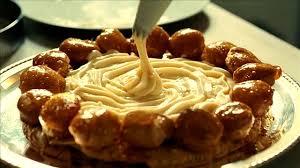
In stark contrast, Hortense goes to great lengths to source her own regional produce, recreating family recipes like “Granny’s Saint-Honoré” which transport the President back to his childhood, much like Guy Grossi’s highly successful Recipes from My Mother’s Kitchen.

Nostalgia-evoking and intimately tied to people and place, surely this is the standard to which all good cooking should aspire.

4 Stars.

Davis, J J 2011, ‘To Make a Revolutionary Cuisine: Gender and Politics in French Kitchens, 1789-1815’, Gender and History, vol. 23, no. 2, pp. 301-320.

Grossi, G 2012, Recipes From My Mother’s Kitchen, Penguin Books, Victoria.

‘Italian’ Florentines Myth Debunked

Tasked with plating up a dish for the Food Fair, I knew to play to my strengths: desserts. After trawling the internet for iconic French, Spanish and Italian sweets, I was reminded of a biscuit my family bakes at Christmas. In Mum’s 1972 edition of the Australian Women’s Weekly Biscuit and Slices Book, I found our Florentines recipe.

Surely this delicious fruit and nut biscuit originated in Florence, right? So I thought. 

To my surprise, exhaustive googling turned up little evidence the biscuit can even be found in Florence, let alone originated there. In fact, the Florentine is most likely a French invention which, like ‘eggs Florentine’ and ‘Florentine quiche’, was simply named after the famous Tuscan city.

Today, the biscuit is eaten all over the world and varies hugely. There’s even a Florentine slice! I’m certain my recipe, which calls for cornflakes and condensed milk, never entered a French patisserie. Though this recipe comes closer to the original Florentine, I decided to stick with my own.

Attempting to spoon small heaps onto the baking trays, I was frustrated to remember the mixture barely combines until after baking. I was rewarded for my patience though. Generously coating the bases of cooled biscuits with melted chocolate is always my favourite part.

Perhaps unwilling to admit to my own misconceptions about this dish’s origin, I chose a simple, rustic presentation on a wooden board instead of a French Nouvelle cuisine inspired large, white plate. 

Returning home with only 2 Florentines left, I couldn’t have been happier with how the dish was received, especially when a friend told me the biscuits reminded her of Christmas too.

How Catalonia Built a Nation Without a State

Having recently travelled through Spain, nothing frustrates me more than seeing the national cuisine reduced to paella and churros in popular perception. Honouring Spain’s culinary diversity, today I’m sharing my favourite regional dessert.

Mel i Mató is a light Catalan sweet, typically enjoyed after a heavy main of meat and seafood. To make the dish, Mató, an unsalted, fresh cheese made from goat’s or cow’s milk, is drizzled generously with honey and served with nuts or dried fruits. Popular since the Middle Ages, this dessert highlights the region’s long culinary history, and heroes an ingredient traditionally produced within the villages surrounding Catalonia’s Monserrat Mountain.

But what could a dessert have to do with nation-building? The answer is complicated.

Despite being part of Spain for centuries, Catalonia remains a semi-autonomous region with its own distinct language, flag and history (Rose 2019). Accordingly, Catalan nationalists resent any encroachment from Madrid on Catalan sovereignty.

As debates continue over the 2017 Independence Referendum, Catalonia looks to its unique cuisine to differentiate itself from the rest of Spain. For example, the Catalan Tourist Board invites visitors to experience the culture and roots of Catalonia which live on in their recipes like Mel i Mato.

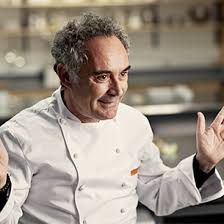
In the absence of recognised sovereignty, Catalan food has become a powerful expression of national identity, earning international attention thanks to wildly inventive chefs like Ferran Adriá (Rosier I Puig 2011, 230). 

Catalonia’s Mató is difficult to source outside of Spain, and in my experience near impossible in Melbourne, but Italian ricotta makes a reasonable substitute.

Or, for those brave enough, it’s possible to make your own…Good luck!

Rose, M 2019, ‘Culinary Nationalism: From Spain Centre and Peripheries’, A Taste of Europe: A Melbourne Intensive, lecture 8, slide 4.

Rosier I Puig, M 2011, ‘What’s Cooking in Catalonia?’ in D Keown (ed), A Companion to Catalan Culture, Tamesis, Woodbridge, pp. 229-53.

Sfogliatelle Before The Sopranos

Naples, the capital of the Campania region, is the proud birthplace not only of Margherita pizza, but also of a delicious sweet that has become emblematic of a region seen as nothing short of a food-lover’s paradise.

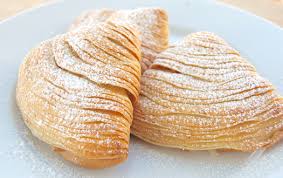
The story goes that in a 17th century convent on the Amalfi Coast, lemon liqueur and milk were added to leftover semolina flour. The cooked pastry was then filled with sugar, ricotta and dried fruit, forming the archetypal Santa Rosa Sfogliatella. Although initially kept secret, the recipe soon travelled to Naples, where a pastry shop on the via Toledo began producing them to overwhelming success. Today, it’s dusted with sugar and accompanied by an espresso in many a Neapolitan breakfast.

Within Italy there are 2 variations: the layered Sfogliatella Riccia and the simpler Sfogliatella Frolla, made of shortcrust pastry. Making the former yourself is a LABORIOUS task (but here’s a recipe if you feel like trying).

Luckily Sfogliatelle are easy to find. Thanks to Italian emigration patterns (Dutton 2019), Italian bakeries are commonplace across Europe, Australia and the United States. Not only did Sfogliatelle feature briefly in an episode of HBO’s The Sopranos, but Americans have created their own version. The Aragosta, or “Lobster Tail”, uses the same dough with a sweeter filling of French cream.

But guess what…

When eaten outside Italy, few realise Sfogliatelle are a Campanian invention. Instead the pastry is attributed to Italy as a whole based on perceptions of a homogenous national cuisine. It seems Priscilla Parkhurst Ferguson (2010, 107) was correct to observe, “seen from afar, the nation subsumes the regions”. And what a shame that is – so credit where credit is due, let’s thank Campania for this delicious pastry!

Dutton, J 2019, ‘Migrant Cuisines and the Transformation of Melbourne’s Foodscape’, A Taste of Europe: A Melbourne Intensive, lecture 5, slide 4.

Parkhurst Ferguson, P 2010, ‘Culinary Nationalism’, Gastronomica, vol. 10, no. 1, pp. 102-109.